Weather and Snowpack
Recent weather dumped abundant snow in the west central Montana mountains. SNOTEL sites above 7000 feet report an average of 48″ with Hoodoo showing 59″, Saddle Mountain 51″, Stuart Pk. 45″ and Lolo and Lookout passes at 32″ each. This newest snow came in moist which results in most mountain locations above 6500 feet starting out with a solid base and no faceted weak layersA snowpack layer with less strength than adjacent layers. Often the layer in the snowpack where an avalanche fractures.A snowpack layer with less strength than adjacent layers. Often the layer in the snowpack where an avalanche fractures.. Missoula Weather Service is again forecasting heavy snow Sunday and Monday.
We’ve received many good reports from the Hoodoo Pass area this week. The avalanche specialists toured into the Rattlesnake Wilderness Friday after setting up the Beacon Park at the top of Montana Snowbowl.
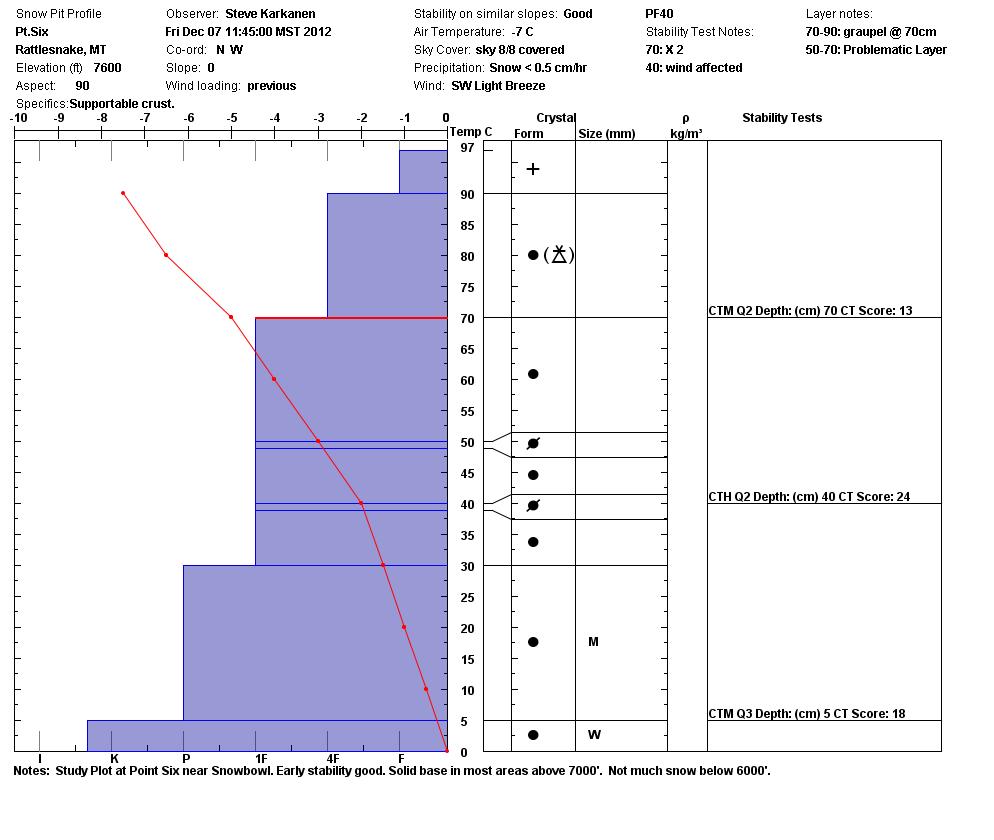
We found a mostly stable snowpack that skied well for the first week of December. There are some considerations that need to find their way into your decision making if you plan to leave ski area boundaries or ride a heavy sled on steep open terrain.
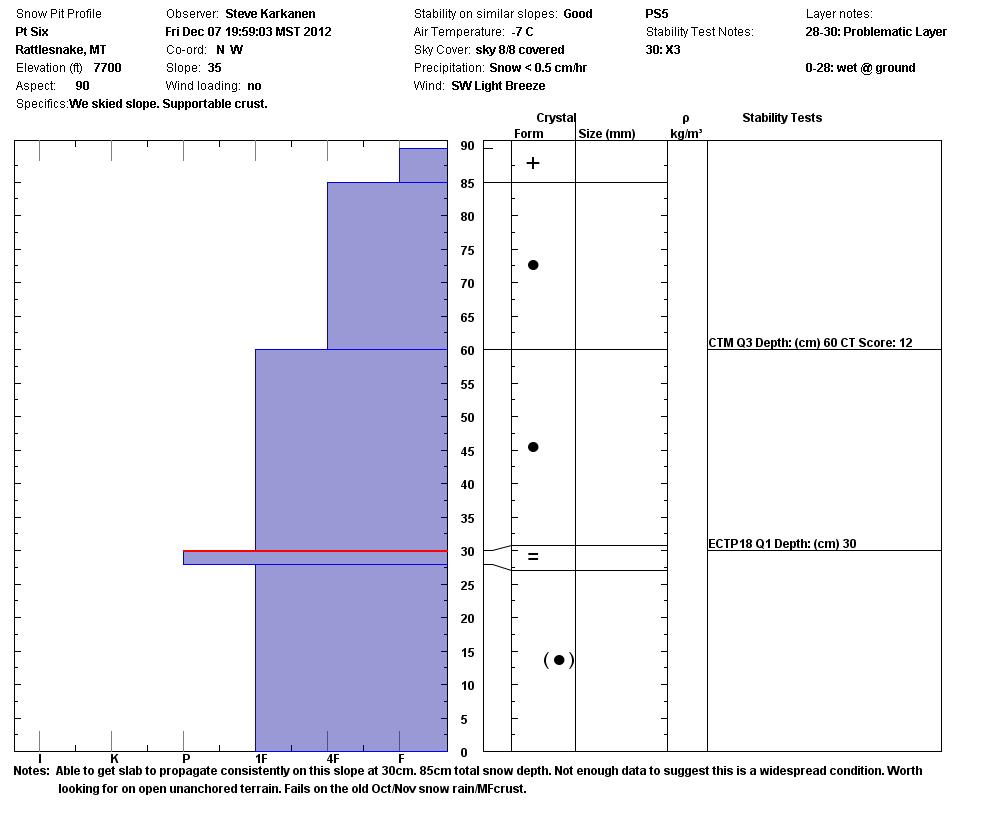
All the pits and stabilityThe chance that an avalanche will not occur, relative to a given trigger (usually the weight of a human). tests indicate mostly stable snow but we did experience minor sluffing on the steepest slope angles involving the new storm snow. These sluffs will be bigger today after last nights heavy snow. Another consideration is that in some areas the snow of the past week or two has not had time to strongly bond to the old early season snow that was exposed to warm temperatures and rain in many locations. On an east aspectThe compass direction a slope faces i.e. North, South, East, West. at 7700 feet I was able to get a 25″ slabA relatively cohesive snowpack layer. A layer of snow stronger than underlying layers.A relatively cohesive snowpack layer. A layer of snow stronger than underlying layers. to propagate consistently on the rain crustA crust is a hard layer of snow where liquid water has refrozen into grain fabric. Crusts usually result from sun, rain or wind.A Rain CrustA crust is a hard layer of snow where liquid water has refrozen into grain fabric. Crusts usually result from sun, rain or wind. is formed by the freezing of infiltrated rain water. It can be thin (from a glaze to a few millimeters thick) or if there is hard rain there may be more of an ice surface than a distinct crustA crust is a hard layer of snow where liquid water has refrozen into grain fabric. Crusts usually result from sun, rain or wind..A clear layer of ice formed when rain falls on the snow surface then freezes. about a foot from the ground. The extended column test score is ECTP18 Q1. You can view these profiles on our photo gallery.
-
-
This alone should make you want to think pretty hard about how steep and how big a line you want to ride. The good thing about this is that most areas don’t yet have enough snow to cover terrain features and vegetation that anchor snow to steep slopes. If you are unsure about a slopes stabilityThe chance that an avalanche will not occur, relative to a given trigger (usually the weight of a human)., dig a quick pit or find less steep or exposed terrain.
The main snow safety concerns during the next few days will be storm snow, development of wind slabsA relatively cohesive snowpack layer. A layer of snow stronger than underlying layers.A cohesive layer of snow formed when wind deposits snow onto leewardWind erodes snow from the windward (upwind) side of an obstacle and deposits snow on the leeward (downwind) side. Deposited snow looks smooth and rounded. You should always beware of recent deposits of wind drifted snow on steep slopes. terrain. Wind slabsA relatively cohesive snowpack layer. A layer of snow stronger than underlying layers. are often smooth and rounded and sometimes sound hollow.A cohesive layer of snow formed when wind deposits snow onto leewardWind erodes snow from the windward (upwind) side of an obstacle and deposits snow on the leeward (downwind) side. Deposited snow looks smooth and rounded. You should always beware of recent deposits of wind drifted snow on steep slopes. terrain. Wind slabsA relatively cohesive snowpack layer. A layer of snow stronger than underlying layers.A cohesive layer of snow formed when wind deposits snow onto leewardWind erodes snow from the windward (upwind) side of an obstacle and deposits snow on the leeward (downwind) side. Deposited snow looks smooth and rounded. You should always beware of recent deposits of wind drifted snow on steep slopes. terrain. Wind slabsA relatively cohesive snowpack layer. A layer of snow stronger than underlying layers. are often smooth and rounded and sometimes sound hollow. are often smooth and rounded and sometimes sound hollow., corniceA mass of snow deposited by the wind, often overhanging, and usually near a sharp terrain break such as a ridge. Cornices can break off unexpectedly and should be approached with caution. collapseWhen the fractureThe physical separation of the slab from the bed surface and surrounding snow during the initiation of a slab avalanche. of a lower snow layer causes an upper layer to fall. Also called a whumpf, this is an obvious sign of instability. and thin snow conditions as you lose elevation. Remember most avalanches happen during and immediately after storms. We saw evidence of the potential for this yesterday and received a report from the Hoodoo area of a natural corniceA mass of snow deposited by the wind, often overhanging, and usually near a sharp terrain break such as a ridge. Cornices can break off unexpectedly and should be approached with caution. fall that triggered a loose snow avalancheA Loose Snow Avalanche or Sluff.An avalanche that releases from a point and spreads downhill collecting more snow - different from a slabA relatively cohesive snowpack layer. A layer of snow stronger than underlying layers.A relatively cohesive snowpack layer. A layer of snow stronger than underlying layers. avalanche. Also called a point-release or sluffA Loose Snow AvalancheA Loose Snow Avalanche or Sluff. or Sluff... We also heard of someone dropping off the edge while kicking cornices in the same area last week. Cornices can be an excellent device to test a slopes stabilityThe chance that an avalanche will not occur, relative to a given trigger (usually the weight of a human). but they have this nasty habit of breaking further back than you might expect.
Early Season Considerations
Now that the ski areas are open and conditions are good for backcountry travel, please keep your safety and the safety of others you may encounter in the backcountry. More people are leaving ski area boundaries for fresh tracks many of whom clueless to the danger they present to themselves, other parties or their rescuers. Side-country is backcountry. No exceptions! You must be prepared to deal with avalanche conditions, survival and rescue on your own.
Always carry an avalanche transceiver, probeA metal rod used to probe through avalanche debris for buried victims. pole and shovel. Go with partners that you know and can deal with an emergency and if you ski or ride on slopes steep enough to slideA mass of snow sliding, tumbling, or flowing down an inclined surface. Same as avalanche., do it one at a time.
We begin the regular Friday/Tuesday advisory program December 21 and will post updates as conditions change. We are not issuing avalanche danger ratings until we start getting consistent data from our partners and observers in the Bitterroot Mountains and near Seeley Lake.